2. Business Model
2.1. Actors and Roles
A PSD2 actor is either an entity or a physical person which can endorse one or several roles.
Most of the roles are defined in PSD2. However some extra-roles have been specified for the purpose of the STET PSD2 API during the analysis phase of the project.
Within the following diagram:
-
Actors have cyan-coloured labels
-
Pure PSD2 roles have green-coloured labels
-
Specific STET PSD2 API roles have red-coloured labels
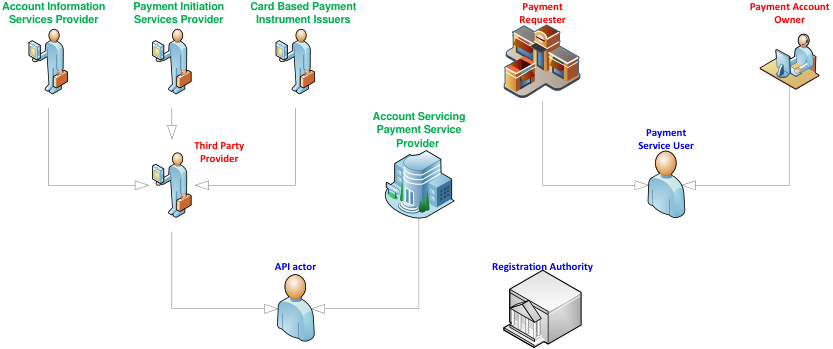
2.1.1. Payment Service User (PSU)
PSUs are the end-users of the services provided by TPPs and ASPSPs.
They are either physical persons or entities (organisations, companies, administrations…).
They do not interact directly with the STET PSD2 API.
A given PSU endorses at least one of the following roles:
-
Payment Account Owner (PAO) for one or several accounts held by one or several ASPSPs.
-
Payment Requester (PR) asking either for a payment or a coverage check.
2.1.2. API actors
2.1.2.1. Account Servicing Payment Service Provider (ASPSP)
These are Payment Service Providers (PSPs) which are in charge of holding payment accounts for their customers (PSU).
2.1.2.2. Third Party Provider (TPP)
These actors can intermediate between PSUs and ASPSPs, acting on behalf of a PAO or a PR.
On one hand, a given PAO may contract with a TPP in order to use the services provided by this TPP:
-
Account Information Services (AISP role) will allow the PAO to get information, through a single interface, about all of his/her accounts, whatever the ASPSP holding this account.
-
Card Based Payment Instrument Issuers (CBPII role) that will check the coverage of a given payment amount by the PSU's account.
On the other hand, a PR may also contract with a TPP that will provide the following services:
- Payment Initiation Services for requesting a Payment Request approval by the PSU and requesting the subsequent execution through a Credit Transfer (PISP role).
2.1.3. Registration Authorities (RA)
RAs are in charge of registering and overviewing the PSD2 actors.
The registration information is the foundation on which each actor can rely in order to know:
-
Who is a given actor?
-
Identity
-
Contacts (business, legal, operational…)
-
Insurance coverage
-
Authentication media
-
X.509 eIDAS certificates (https://eur-lex.europa.eu/eli/reg/2014/910/oj ) QWAC for TLS mutual authentication QSEALC for content signature
-
Certification chain and services (revocation list, OCSP)
-
-
-
For which roles this actor has been registered
-
AISP
-
PISP
-
CBPII
-
ASPSP
-
-
Technical characteristics
oAPIs that are provided- URLs that are to be used, for test or live processing.
Registration Authorities must keep track of changes for each actor in order to recover the full history of the actor.
2.2. Use cases
Some of the use cases that are listed below are directly implemented by the STET PSD2 API, for they rely on interactions between TPPs and ASPSPs.
Other uses cases are tagged as "NON-API" and are only described for global understanding purpose.
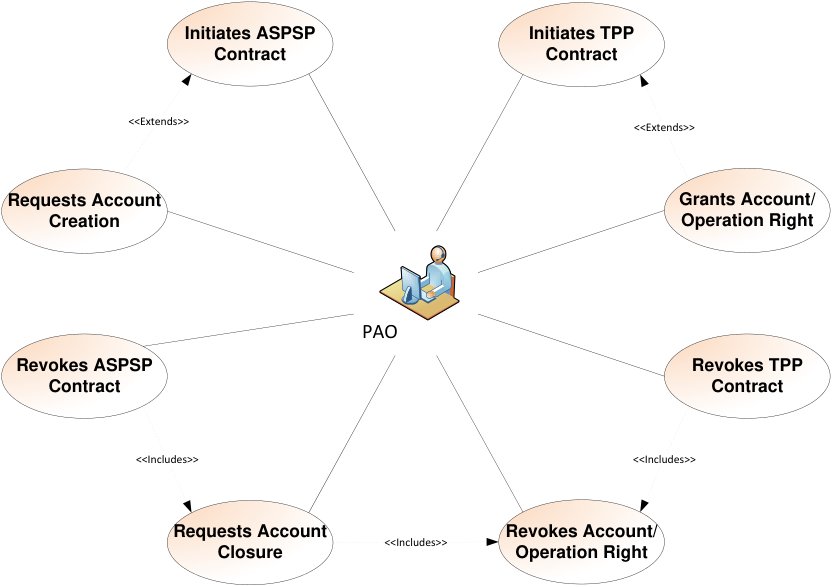
2.2.1. PAO uses cases (NON-API)
| USE CASE (PAO) | DESCRIPTION | INTERACTIONS |
|---|---|---|
| Initiates ASPSP Contract | The user contracts with an ASPSP in order to use its services. This use case is likely extended by one or more occurrences of the "Requests Account Creation" use case | ASPSP |
| Requests Account Creation | The user asks the ASPSP to open a new payment account Requires a contract between the PAO and the ASPSP | ASPSP |
| Requests Account Closure | The user asks the ASPSP to close an existing payment account This use case includes the "revokes Account/Operation Accreditation" use case for all operations on this account and for all granted TPP. | ASPSP TPP (indirectly) |
| USE CASE (PAO) | DESCRIPTION | INTERACTIONS |
|---|---|---|
| Revokes ASPSP Contract | The user revokes the contract with the ASPSP This use case includes the "Requests Account Closure" use case for each account that is held by the ASPSP. This use case includes the "Revokes Account/Operation Accreditation" use case for all operations on each of these accounts and for all granted TPP. | ASPSP TPP (indirectly) |
| Initiates TPP Contract | The user contracts with a TPP having AISP and/or CBPII roles in order to use its service This use case is likely extended by one or more occurrences of the "Grants Account/Operation Accreditation" use case | TPP |
| Grants Account/Operation accreditation | The user allows the TPP to access a given set of operations on one of his/her payment accounts. Requires a contract between the PAO and the ASPSP, a contract between the PAO and the TPP and the registration of this PAO-TPP relationship by the ASPSP to enable the OAUTH2 token management (cf. §3.4.2). Requires also that the capture and the execution of the accreditations are handled by the TPP (the further forwarding of these accreditations is an AISP use case and so out of scope of this use case: cf. §2.2.3). | ASPSP TPP |
| Revokes Account/Operation accreditation | The user asks the ASPSP to revoke the TPP access for a given set of operations on a given PAO account. Requires that the capture and the execution of the revocation are handled by the TPP. | ASPSP TPP |
| Revokes TPP Contract | The user revokes the contract with the TPP. This use case includes the "Revokes Account/Operation Accreditation" for all grants given to the TPP, whatever the ASPSP. Since this cannot be automated, it is the PAO's duty to initiate all the relevant revocations with each ASPSP. | TPP ASPSP |
2.2.2. Registration use cases (NON-API)
| PSD2 Actor Revokes Registration Manages Roles Initiates Registration Queries Registration Directory Registers a PSD2 Actor «Extends» «Extends» «Includes» | PSD2 Actor Revokes Registration Manages Roles Initiates Registration Queries Registration Directory Registers a PSD2 Actor «Extends» «Extends» «Includes» | PSD2 Actor Revokes Registration Manages Roles Initiates Registration Queries Registration Directory Registers a PSD2 Actor «Extends» «Extends» «Includes» |
|---|---|---|
| USE CASE (PSD2 ACTOR) | DESCRIPTION | INTERACTIONS |
| Initiates Registration | The user asks the RA for registration. This use case is likely extended by one or more occurrences of the "Manages Roles" use cases | RA other actors (indirectly) |
| Manages Roles | The user asks the RA to be referenced for a given set of roles. This use case can be replayed in order to reference or dereference any role. | RA other actors (indirectly) |
| Revokes registration | The user informs the RA that its registration is to be cancelled | RA other actors (indirectly) |
| Queries Registration Directory | The user queries the RA directory in order to get data on other PSD2 actors: roles, certificates… | RA other actors (indirectly) |
| Registers a PSD2 actor | The user registers a given PSD2 actor into its own Directory | None |
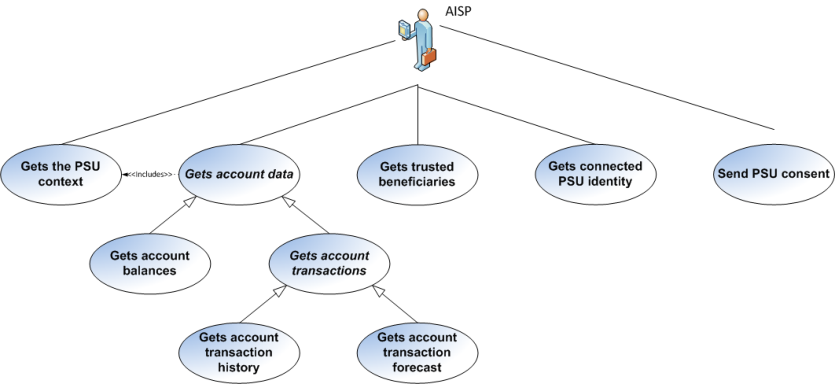
2.2.3. AISP use cases
| USE CASE (AISP) | DESCRIPTION | INTERACTIONS |
|---|---|---|
| Gets the PSU Context | The user queries the ASPSP in order to get the payment accounts that are eligible for the relevant PSU. | ASPSP |
| Sends the PSU consent to the ASPSP | Having captured the consent choices from the PSU, the user sends them to the ASPSP | ASPSP |
| Gets Account Data | This use case is abstract. Its purpose is to stress that the "Gets the PSU Context" is a prerequisite for all other use cases on a given account | none |
| Gets Account Balance | The user queries the ASPSP in order to get the balance on one given account. The ASPSP can provide several balance computing's (Instant Balance, Accounting Balance…), each balance type being specified with an explicit label. | ASPSP |
| Gets List of Transactions | This use case is abstract and can be seen as the common interface for the two following uses-cases. | ASPSP |
| Gets Account Transaction History | The user queries the ASPSP in order to get all the transactions that have been committed to one given PSU account within a given range of value dates. | ASPSP |
| Gets Account Transaction Forecast | The user queries the ASPSP in order to get all the transactions that are known by the ASPSP to be committed to a given PSU account | ASPSP |
| Gets connected PSU identity | The user queries the ASPSP in order to get the identity of the PSU on behalf of whom the AISP is connected | ASPSP |
| Gets trusted beneficiaries | The user queries the ASPSP in order to get all the beneficiaries that were registered as "trusted" par the PSU. | ASPSP |
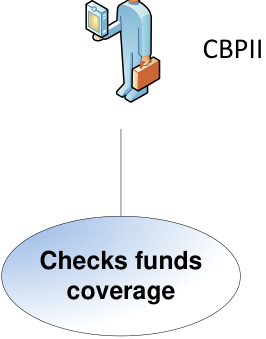
2.2.4. CBPII use cases
| USE CASE (CBPII) | DESCRIPTION | INTERACTIONS |
|---|---|---|
| Checks Funds Coverage | The user queries the ASPSP in order to check if a given transaction amount can be covered by one given PSU account | ASPSP |
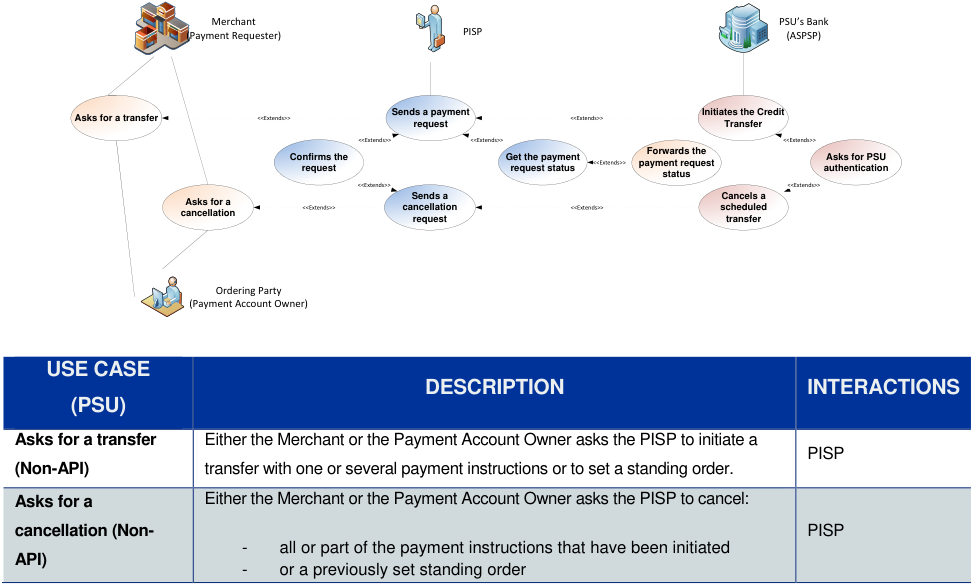
2.2.5. PISP uses cases
| USE CASE (PISP) | DESCRIPTION | INTERACTIONS |
|---|---|---|
| Sends a Payment Request | The user sends to the ASPSP all the information needed to initiate a Payment. The payment might have been requested either by the beneficiary (e.g. Merchant) or by the account owner him/herself. The payment may include one or several instructions, the maximum number of instructions can be specified by each ASPSP. Those instructions might have - Either a same requested execution date but multiple beneficiaries - Or a same beneficiary but different requested executions dates, those being either explicitly specified or scheduled through a given periodicity (standing orders) | ASPSP |
| Sends a cancellation request | The user sends to the ASPSP a request to cancel, from a previously posted payment request, one, several or all instructions provided that they have not yet been executed. Cancellations can be performed by sending the Payment request with modifications of the status and reason code at payment level and/or at instruction level. | ASPSP |
| Confirms the Request | The user confirms the Payment Request or the Cancellation Request to the ASPSP and might forward, through an EMBEDDED approach, a PAO authentication factor so that the ASPSP can complete the PAO authentication and process the request. | ASPSP |
| USE CASE (PISP) | DESCRIPTION | INTERACTIONS |
|---|---|---|
| Gets the Payment Request status | The user gets the status of the Payment Request from the ASPSP. This status embeds: - Information about the payment request and the execution of the subsequent Credit Transfers - Information about the effective booking of the payment instructions that are about to be executed - Information about the availability of funds for payment instructions that are about to be executed but are not effectively booked - Information about the trust given by the PSU to the beneficiary of thepayment | ASPSP |
| Forwards the Payment Request status to the Creditor (Non-API) | The user informs the PR of the status of the Payment Request | PR (Creditor) |
| USE CASE (ASPSP) | DESCRIPTION | INTERACTIONS |
| Asks for PSU authentication (Non- API) | Provided the Payment Request is valid, the user asks the PAO in order to authenticate before execution of the relevant Payment Request or Cancellation Request | PSU(PAO) |
| Initiates the Credit Transfer (Non-API) | Provided the PAO has authenticated and the PISP has confirmed the payment request, the ASPSP initiates the relevant Credit Transfer. | Beneficiary's ASPSP (Creditor Agent) |
| Cancels a scheduled transfer (Non-API) | Provided the PAO has authenticated and the relevant transfers have not yet been executed, the ASPSP cancels the execution of the instructions that were specified by the PISP | None |